Stormlit Ocean Lighthouse
claude-fable-5-2· thinking max· threejs· Nov 9, 2026, 09:17 PM UTCScore
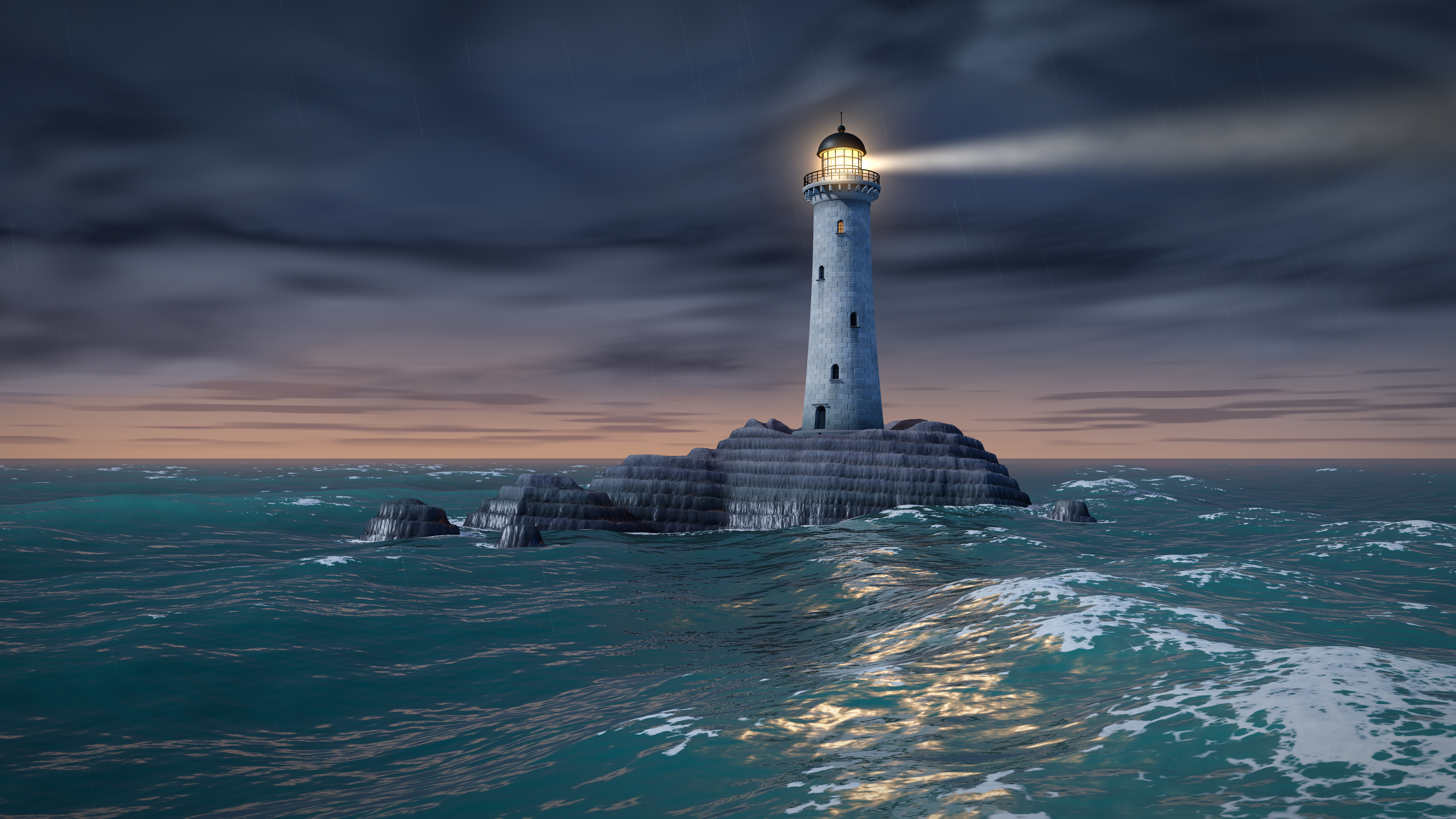
A strong, cohesive coastal scene with convincing animated swells, a clearly articulated lighthouse and sustained atmospheric lighting. Repetitive rock contours, occasionally broad foam patches and an overbright beacon at some angles keep it below exceptional cinematic realism.
Rubric judgment
A detailed tapered lighthouse, gallery and warm glazed lantern sit convincingly on eroded rock. Smooth architectural silhouettes and real three-dimensional depth remain readable against the storm sky.
Geometric swells travel coherently with smaller ripples, changing surface normals and restrained crest or shoreline foam. Water has depth and scale, without a flat scrolling texture, frozen foam grid or exposed mesh boundaries.
Amber lantern light and a soft sweeping beacon contrast with cool storm colours. Tower, rocks and waves retain readable form throughout; atmospheric effects and wet highlights feel integrated rather than opaque cones, blown bloom or darkness.
The default composition connects foreground crests, the lighthouse and a layered horizon. A restrained camera drift and visible beacon pass maintain interest throughout all ten seconds while preserving the complete tower and stable horizon.
The scene starts automatically and runs smoothly through the capture and performance probe, with no geometry popping, prominent shoreline intersections, transparent-layer flicker, abrupt resets or overlays.
A strong, cohesive coastal scene with convincing animated swells, a clearly articulated lighthouse and sustained atmospheric lighting. Repetitive rock contours, occasionally broad foam patches and an overbright beacon at some angles keep it below exceptional cinematic realism.
- Smooth tapered tower includes inset windows, gallery railings, glazed lantern and rounded roof, all readable throughout.
- Changing foreground swells, ripples and broken foam establish convincing ocean depth and continuous movement.
- The beacon visibly completes a sweep while the lantern maintains its warm glow against the cool storm palette.
- Complete opening composition remains stable and unobstructed; the performance probe reports approximately 60 fps with no errors.
- The outcrop's uniformly stepped contours and repetitive vertical markings look manufactured rather than naturally eroded.
- Some foreground foam expands into broad, flat-looking white patches rather than narrow crest traces.
- The camera-facing beacon becomes conspicuously bright and broad, reducing the otherwise restrained atmospheric treatment.
- Camera drift is barely perceptible, providing limited evolving parallax across the shot.
Brief
A warm lighthouse beacon sweeps across rolling teal waves beneath a layered storm sky during a continuous dusk camera drift.
Full generation brief
Create a cinematic coastal shot at blue hour: a weathered pale lighthouse stands on a dark sculpted rock outcrop just right of centre, surrounded by rolling petrol-teal water. Its warm amber lantern is the visual anchor. Large foreground wave crests lead diagonally toward the tower, with distant slate-blue storm clouds and a narrow, dim peach band near the horizon. The first frame must already contain the complete, illuminated scene.

Build and art direction:
- Model a recognisable tapered lighthouse with a masonry shaft, inset windows, a gallery railing and a glazed lantern room under a rounded roof. Use smooth silhouettes and restrained procedural weathering. Give the outcrop layered, eroded contours rather than a pile of coarse polyhedra; the tower must visibly rest on it.
- The ocean must be a real subdivided 3D surface with multiple combined travelling wave directions. Large swells carry smaller ripples; animate the geometry as well as its shading. Use a wet PBR finish with coherent changing normals and a controlled reflected sky colour. Add narrow, broken pale foam at selected crests and around the rocks; foam should follow wave height or shoreline interaction rather than form a static white grid.
- A cool moonlike key and dim blue fill reveal the tower and rock, with real shadows. The lantern supplies warm local light. Its rotating beacon has a soft atmospheric shaft and a corresponding moving light direction, so it reads as illumination passing through mist rather than a solid opaque cone. Procedural mist layers and a few rain streaks are optional supporting details, never a veil that hides the scene.
- Give the storm sky layered cloud structure and a readable horizon using procedural colour, noise or geometry. Keep navy, slate and teal dominant, with amber concentrated at the lantern and its reflection. Do not turn the whole frame black or neon.

Motion and camera:
- Start with rolling swells, visible foam and the beacon already sweeping. Use a continuous beacon cycle of roughly 6-8 seconds so the 10-second capture includes a clearly visible pass across the water. Maintain a steady warm lantern glow even when its shaft points away from the camera.
- Use a slow lateral camera drift with a very small elevation change from a low three-quarter offshore view. Keep the lighthouse fully visible, including its base and roof, and preserve foreground water and horizon at all times. Override the default OrbitControls requirement with this authored path; interaction is not required.
- Keep waves, foam and the beacon moving throughout the capture and beyond; no staged reveal, cuts, fade to black, freeze at ten seconds or abrupt reset. Any lightning is optional and subordinate; do not rely on a brief flash to make the scene legible.